
Train Your Child's Most Important Muscle
Did you know that the part of our brain that helps us pause, reflect, and make good choices doesn't fully develop until age 25?
Which explains basically everything about our 20s ; )
Thankfully, parents like you are changing that story. By intentionally teaching emotional intelligence now, your kids are developing skills most of us didn't find until adulthood.
This month we've been exploring Choice Power — the Hero Intelligence® capacity that shifts kids from things just happen to me to I have a say in what happens next.
And it all comes down to one sequence: self-talk shapes emotion, and emotion drives action.
That's why we've been working on something new here at REK. A story built to give kids a language for what's happening inside them.
It stars a character named Milo. He's purple. He feels everything loudly. And he just might become one of your family's most useful tools this year.
Meet Milo
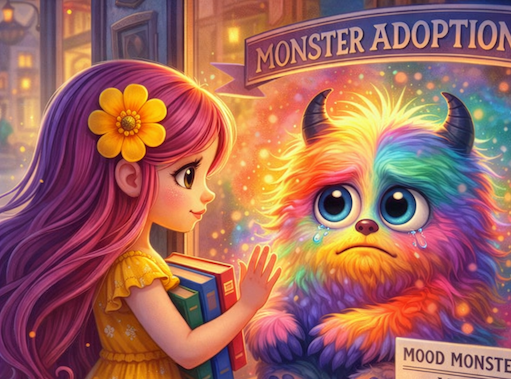
This week, we want to introduce you to someone.
We've been working on a children's book right here at REK. It's built around one idea: every child has three voices inside them, and learning which one to follow is one of the most powerful choice skills they'll ever develop.
There's a monster named Milo, all fluffy and small,
whose colors change faster than autumn leaves fall.
Blue when he's lonely. Red when he's mad.
Yellow for hopeful. Black when things feel bad.
He flickers. He shifts. He just can't find his way.
One color won't stay — not even for a day.
Inside him, three voices all want to be heard.
One whispers in fear. One shouts without words.
And one — very quiet — says: breathe, you are safe.
But which voice to follow? That's Milo's big race.
Then one afternoon, through a shop window glass,
a girl pressed her hand... and the colors held fast.
She said: "I'll take him". The shopkeeper warned:
"Do you know what you're taking on — are you up to the task?"
She smiled: "Then we'll help him find his guide."
And that's where it starts — what will Milo decide?
The Moody Monster Check-In
Elite athletes train their minds the same way they train their bodies.
They call it the art of mental performance.
The same skills that help a professional stay calm under pressure, noticing thoughts, managing emotions, choosing a response, are skills kids can build too. They just need the reps.
That's the Moody Monster Check-In.
Every kid has a Moody Monster inside them. Not because they're difficult but because they feel everything. And every feeling starts a loop: a thought triggers a feeling, a feeling drives an action. Do it enough times and it shapes identity.
The check-in is one rep.
Think about the last time your child hit a wall like a tough homework question, a fight with a sibling, something that felt unfair. Before they said or did anything, a voice fired first. It always does.
In a calm moment at dinner, in the car, or before bed, ask: "Which Moody Monster showed up today?" Then share yours first. "Mine was pretty loud this afternoon, honestly."
Language is how the loop changes.
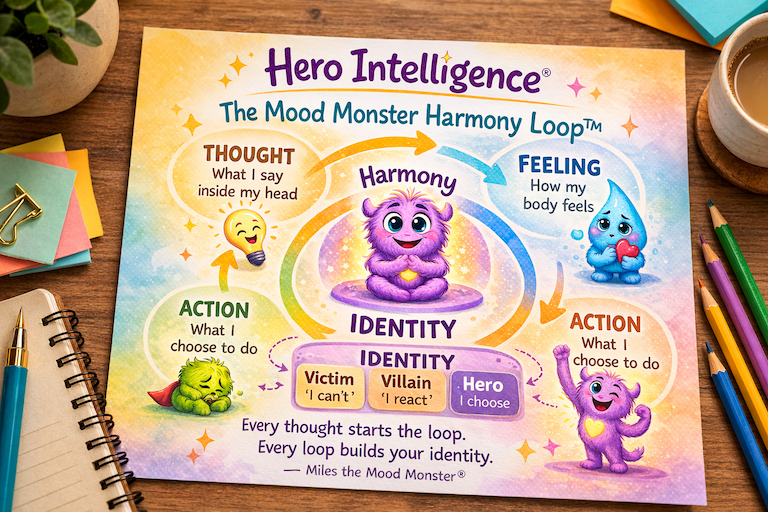
Want to put the loop on your wall or classroom?
We made a free printable of the Mood Monster Harmony Loop for REK members.
Before you go…
True or False: Four leaf clovers aren't real.
False! They're a natural mutation — about one in every 5,000 clovers. Each leaf is said to mean something: faith, hope, love, and luck.
The best things are worth looking for....our Hero Voice.
And just like any muscle, it gets stronger the more you train it.
Our very own Hero Intelligence Teacher Tammy Vallieres has spent years teaching kids and adults how to do exactly that — and this talk is worth every minute.
Source: Cracking the Rich Code with Tammy Vallieres and John Verrico
Next week we're talking about the one skill that changes how your kids handle every hard conversation. Plus, what do Milo the Mood Monster and Harmony Hare have in common? Find out next week.
Until then, may the luck you find this week be the kind you made yourself. 🍀
Your friends at REK,
Adam & Matthew Toren, Sylvia Tam, and Tammy Vallieres

Our new member hub is live — free activities, conversation starters, and resources for your family. Access it here.
“Who do you want driving your vehicle? You want to listen to what the victim and villain have to say — but you want the hero driving the bus.”