

Today is National Ice Cream Day! Perfect for the summer heat.
Yesterday, on the other hand, was Nelson Mandela International Day where people everywhere give 67 minutes of service in honor of the 67 years Mandela dedicated to others.
It feels like the right weekend to talk about the kind of decision that changes everything.
This week we're looking at the piece that connects the inner compass to the outside world.
Making a decision. Your own decision. Without waiting for the room to agree.
Developmental psychologist Laurence Steinberg has spent decades studying how young people learn to make independent choices. What he found is both reassuring and sobering: the ability to make decisions without needing peer consensus is something kids actually have to practice. It doesn't just arrive.
The good news is that it can start very small. And since we’re celebrating ice cream today, we made you something fun to try with your kids this week — more on that at the end.
This week, the story of a man who made one of the most consequential decisions in modern history alone, in a prison cell, without asking anyone's permission.
STORY
The Choice to Wait for True Freedom

In 1985, Nelson Mandela had been in prison for 21 years.
He was 67 years old, living in an eight-by-eight-foot cell on Robben Island. His health was declining. He had not seen his wife freely in years. His children had grown up without him. The ANC, the organization he had given his life to, was fractured and under siege.
Then the South African government made an offer: walk out. Go home. Be free.
The only condition was that Mandela publicly renounce violence as a political strategy.
His lawyers urged him to consider it. His advisors were divided. The world was watching. After two decades of imprisonment, no one would have blamed him for saying yes.
Mandela sat with the decision alone. He turned it down.
"Only free men can negotiate," he said. "Prisoners cannot enter into contracts."
He chose five more years in that cell over a freedom that came with conditions he hadn't set himself. It was a decision that required no consensus, no poll, no committee. Just a clear read of his own internal compass and the courage to follow it.
He was released unconditionally in 1990. Four years later, he became South Africa's first democratically elected president.
The decision made in a prison cell — the one nobody else could make for him — was the one that mattered most.
SKILL
The Sovereign Strategy
When your child has a decision to make this week, what's the first thing they do?
For most kids, the answer is: ask someone. A parent, a friend, a sibling. Which is fine. But Laurence Steinberg's research shows that the ability to make a decision independently — to form your own view before polling the room — is a skill that needs deliberate practice, especially in the years before adolescence when peer influence is at its peak.
This week, try the Sovereign Strategy.
Find one small decision your child needs to make like what to do this afternoon, which book to start, how to handle a situation with a friend. Before they ask anyone else, sit with them and say:
"What do you think you should do? Just you, before we talk about it."
Then wait. Give them the full space to form an answer without filling it for them.
You're not withholding support. You're giving them something more valuable: the experience of trusting their own judgment before outsourcing it.
The goal isn't the right decision. It's the practice of making one.
Before you go…
Camp SuperNova wrapped up Friday and what a ride it was. Our Campers showed up, dove in, and surprised us in the best ways. We'll be sharing highlights soon and if your child wasn't with us this time, we're already looking forward to next time.
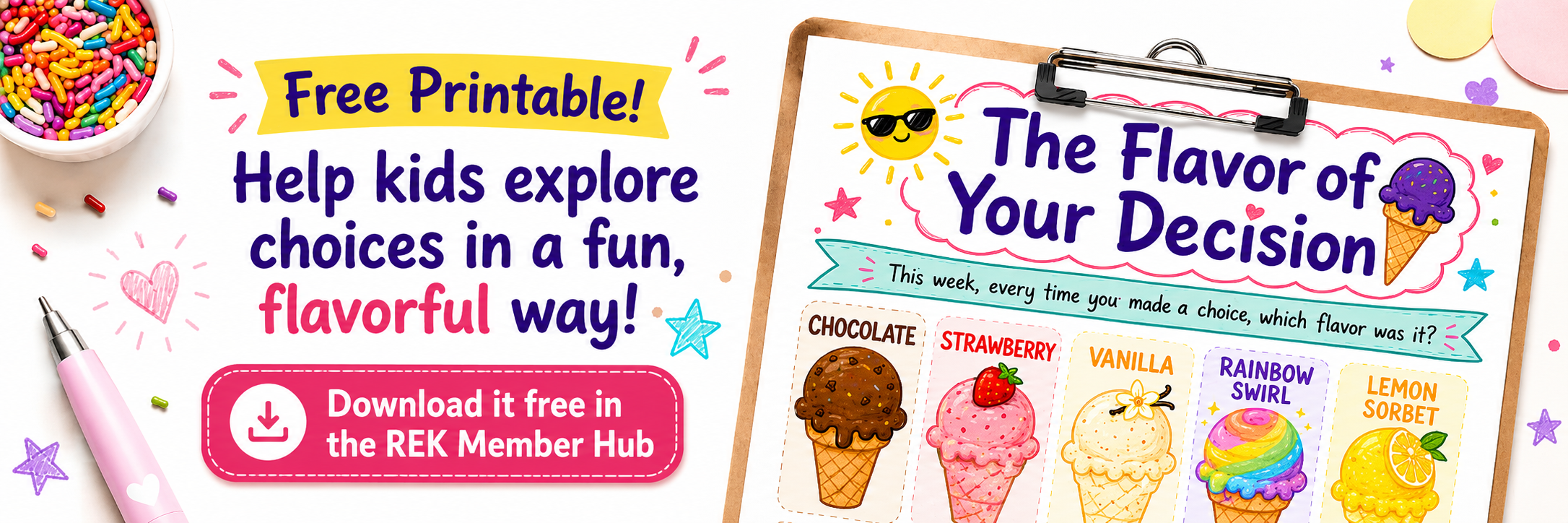
Now for the sweet part….your child can have fun reflecting on their choices with our free Flavor of Your Decision printable. It helps them look back on the choices they made, build confidence, and recognize their bravest decision of the week.
If you’re curious what’s happening inside your child’s brain when they make a decision, here’s a 3-minute explanation from Dr. Laurence Steinberg might just change how you see their choices.
Source: Dr. Laurence Steinberg, Temple University — Understanding the Adolescent Brain
Next week, we’ll wrap up Self-Trust Month. Until then, here’s to a week of small choices, new discoveries, and growing confidence along the way.
Your friends at REK,
Adam & Matthew Toren, Sylvia Tam, and Tammy Vallieres

Our new member hub is live — free activities, conversation starters, and resources for your family. Access it here.
“There are times when a leader must move out ahead of the flock and go off in a new direction, confident that he is leading people the right way.”