

Can you believe it's already the last Sunday of July? Summer has a way of doing that — blinking and suddenly it's almost August.
This is actually a beautiful week to slow down and check in. International Self-Care Day just passed, and we think the truest form of self-care isn't a bath bomb or a morning routine. It's this: actually listening to yourself.
That's what this whole month has been about. And this week we close it out with the most important piece.
Psychologist T.P. Skripkina spent years studying what she calls the internal compass — the quiet, stabilizing structure inside each of us that knows what we need, what we believe, and what feels true. Her research shows that compass doesn't break all at once. It gets worn down gradually, by repeated experiences of being told our instincts are wrong.
The good news: it can be recalibrated. At any age. Including right now, this summer, with the kids in your life.
This week, we tell the story of an elephant. And what it teaches us about how self-trust gets installed — and how it can be reclaimed.
STORY
The Belief is The Chain

Somewhere in the world right now, a fully grown elephant is standing still, held in place by a thin ribbon tied around its ankle.
It could walk away. It could snap that ribbon without effort. But it doesn't try.
Here's why. When that elephant was a calf, it was chained to a heavy stake in the ground. It pulled and struggled and couldn't break free. It tried again. It couldn't. Eventually it stopped trying.
Over time, the trainers replaced the heavy chain with a rope. Then a cord. Then a ribbon. Each time, the elephant tested it less. Not because it was getting weaker. Because it was learning a belief: the thing around my ankle is stronger than I am.
By the time the elephant is fully grown and strong enough to uproot a tree, the belief is so deeply installed that a ribbon is enough to hold it still.
Psychologists call this learned helplessness. And it doesn't only happen to elephants.
When a child is told, again and again, that their instincts are wrong — their feelings are too much, their ideas won't work, their body isn't right, their read on a situation can't be trusted — they learn the same thing.
The chain isn't even there anymore. But the belief is.
The ribbon has no power. It never did. It only works if the elephant has forgotten what it's made of.
SKILL
The Boundary Vault
Has your child ever stopped doing something they loved because someone else's opinion got too loud?
T.P. Skripkina's research shows that self-trust isn't fixed. It can be eroded gradually by repeated experiences of having our own perceptions overridden. For kids especially, the voices of teachers, coaches, peers, and institutions can start to feel more authoritative than their own inner signal.
The skill this week is called the Boundary Vault. It's simple, and it works for any age.
Find a moment this week when your child expresses a preference, an opinion, or a feeling about themselves. Something small is fine. And instead of evaluating it, agreeing or disagreeing, redirect it back to them:
"That's your read on it. Do you trust that?"
You're not confirming their view. You're reinforcing something more important: that their view is worth checking first, before it goes out to the world for approval.
That's a skill. And it starts in small moments.
Before you go…
This week, our co-founder Tammy flew all the way from Canada to Ireland to visit our impact partner, Karina Murray, founder of Aunua Global. Together, they shared Harmony Hare and Her Three Voices with children at a local nursery school and introduced simple tools that help young children recognize their feelings, build self-confidence, and practice kindness.
Seeing these conversations begin in classrooms on the other side of the world reminds us that every child deserves the chance to grow up believing in themselves.
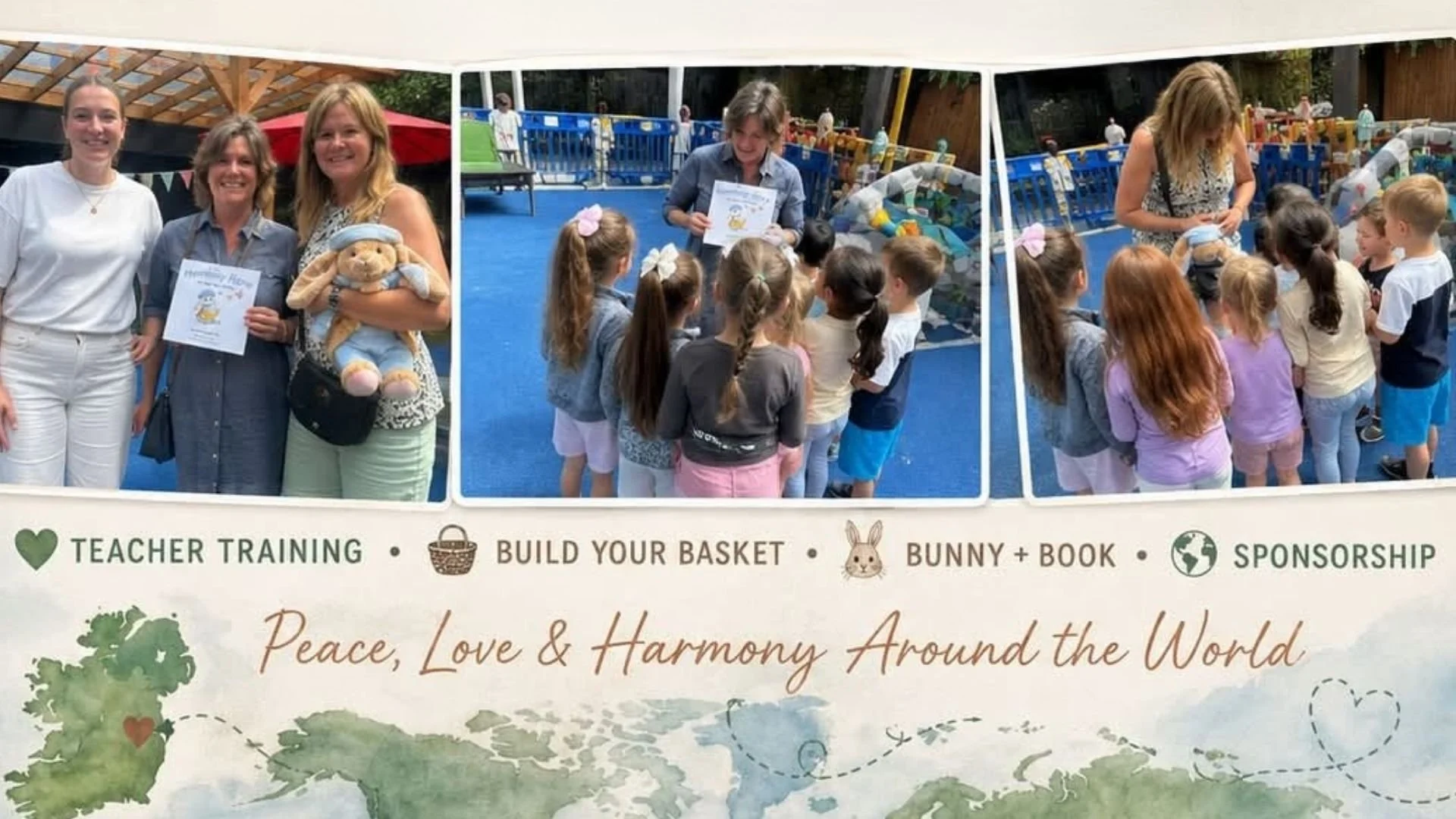
Tammy Vallieres and Karina Murray sharing Harmony Hare at St. Brigid’s Day Nursery in Ireland
If you know a school, educator, or community organization that would love to bring Harmony Hare or our peace education resources to their community, let us know. We’d love to connect!
And as always, the Hero in Us Sees the Hero in YOUth. ❤️
Your friends at REK,
Adam & Matthew Toren, Sylvia Tam, and Tammy Vallieres

Our new member hub is live — free activities, conversation starters, and resources for your family. Access it here.
“Trust yourself. You know more than you think you do.”