
Why Nerves Might Be a Good Sign

Picture this: you're about to sing karaoke. Before the music starts, you're asked to say one sentence out loud.
"I am calm." Or "I am anxious." Or "I am excited."
When Harvard Business School researcher Alison Wood Brooks tried this, the people who said "I am excited" sang best. Two little words. That's all it took.
Is there a big moment on your child's calendar right now? A test. A tryout. A recital. For a lot of high schoolers, October also brings the PSAT, a practice run for the SAT college admissions test.
Since we're exploring Adaptive Strength, a part of adapting is learning to read those butterflies a little differently.
HERO STORY
A Racing Heart on the Way to the Moon
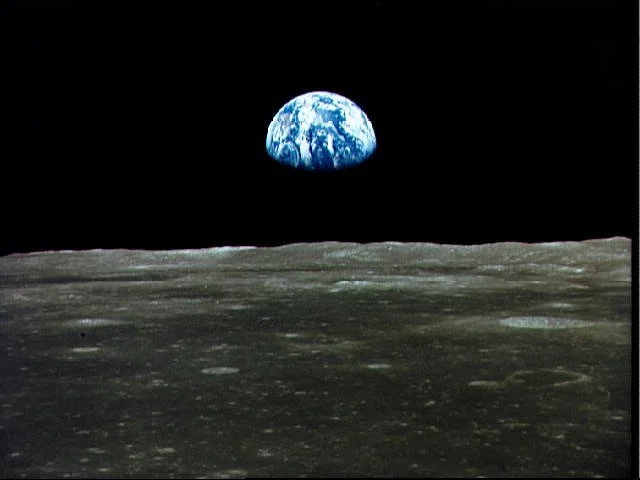
Earthrise during Apollo 11, July 20, 1969. Photo: NASA (AS11-44-6552)
In the summer of 1969, three astronauts blasted off toward the Moon. No person had ever stood there before. Not one.
Two of them, Neil Armstrong and Buzz Aldrin, climbed into a small spacecraft called the Eagle and began dropping toward the Moon's surface. Back on Earth, millions of families watched on TV.
Then something went wrong.
Beep. Beep. Beep. Alarms went off inside the Eagle. Mission Control had only seconds to decide: keep going, or turn back?
"Keep going," they said.
Then Neil looked out his little window. Their landing spot was covered in giant boulders, some as big as cars. If the Eagle landed there, it could tip over.
So Neil took the controls and flew the Eagle himself, gliding over the rocks, searching for a flat, safe spot. And the fuel was running low.
Neil was known as one of the calmest pilots in the world. He didn't yell. He didn't panic. But NASA was measuring his heartbeat the whole time.
What do you think his heart was doing?
It was racing. About 150 beats a minute. That's how fast your heart goes after you sprint across the playground. Then, with just seconds of fuel to spare, the Eagle touched down.
"Houston, Tranquility Base here. The Eagle has landed."
Neil had a pounding heart. And he landed on the Moon anyway. His heart wasn't telling him to stop. It was helping him fly.
A racing heart doesn't mean you're not ready. Sometimes it's what gets you there.
THE TINY TRY
Rename the Butterflies
What does your child say to themselves right before something big?
Maybe it's "I'm so nervous." Maybe it's "I'm going to mess up." Most of us have a version.
Why it helps Nervous and excited feel almost the same in the body. Fast heartbeat, fluttery stomach, a jolt of energy. Calling it excitement points all that energy toward what could go right, just like the karaoke singers.
Want to give it a try? Next time your child has butterflies before a test, game, or performance, say it together, out loud: "I'm excited!"
For younger kids (5–9): Make it playful. Put a hand on your tummy and say, "My butterflies are getting ready to fly!"
For older kids (10–17): Remind them of Neil Armstrong's racing heart. Even the calmest pilot in the world had butterflies.
It might feel a little silly the first time. That's okay. Silly still counts.
Before you go…
Yesterday Oct 10th was World Mental Health Day, a nice reminder that the way we talk about stress at home matters. Kids learn a lot about their own feelings from the words we use for ours.
Stanford health psychologist Kelly McGonigal used to teach that stress was the enemy. Then the research changed her mind. Her TED talk is warm, surprising, and might change how you see your own racing heart, too.
Source: TED, Speaker Kelly McGonigal
Next Sunday: the one little sentence that helps us feel braver, and it's simpler than you'd think.
But until then, here's to a few butterflies ready to fly, and an Eagle has landed moment of your own this week.
Your friends at REK,
Adam & Matthew Toren, Sylvia Tam, and Tammy Vallieres

Our new member hub is live — free activities, conversation starters, and resources for your family. Access it here.
“When you choose to view your stress response as helpful, you create the biology of courage.”