
Vulnerability Is the Valentine
We usually think love looks like being wanted.
Brené Brown’s research says it actually looks more like being seen.
Over and over in her studies, she found that the strongest connections—between partners, friends, families—are built on vulnerability. Not impressing. Not performing. Letting yourself be known, even when it’s uncomfortable.
Which sounds lovely, until you’re parenting.
Because when our kids want to belong, we don’t hand them chocolates and hearts. We hand them strategies. How to be easier. How to keep people happy. How to stay liked.
And without meaning to, we can teach a dangerous little lesson:
Love stays when you give enough of yourself away.
That’s why this week’s story matters.
Because long before kids have the words for vulnerability or boundaries, they absorb the message from stories—especially the ones that feel warm and familiar.
Enter The Giving Tree.
The Giving Tree (the belonging trap)
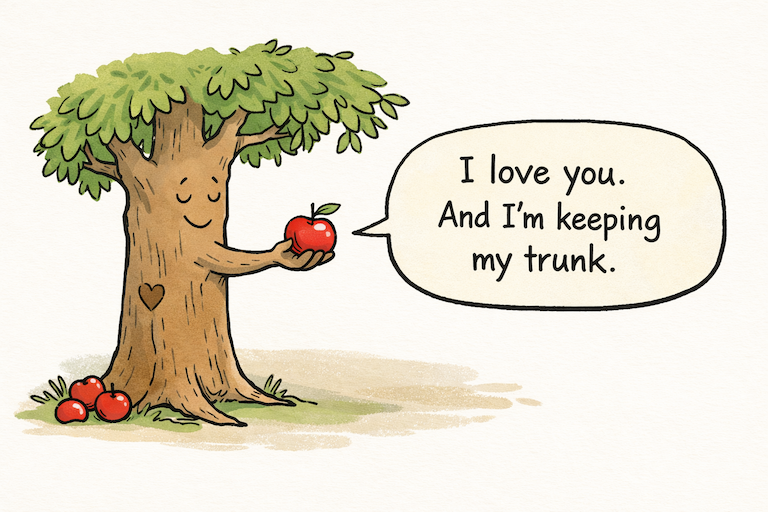
The Giving Tree isn’t really a children’s story.
It’s a mirror.
A boy comes back again and again.
Each time, the tree gives him what he wants.
First apples.
Then branches.
Then its trunk.
The tree never says no.
It never protects itself.
And that’s what makes the story feel sweet—
until it doesn’t.
Read through a belonging lens, the message turns:
If I give enough…
If I stay useful…
If I don’t ask for much…
I get to stay loved.
That’s not belonging.
That’s a deal.
There’s a name for this pattern: self-erasure—staying connected by disappearing.
It shows up when kids say “I’m fine” but aren’t.
When they shift depending on who they’re with.
When they apologize just to keep the peace.
The opposite of self-erasure isn’t being loud or difficult.
It’s staying real and still feeling safe in connection.
Let’s think for a minute…
Where do we see our kids giving pieces of themselves away to belong?
What would change if they believed: “I don’t have to disappear to be loved”?
Shift the Language
This week, try one small shift at home. When your child uses fitting-in language, don’t correct it. Translate it.
You’re not fixing them. You’re helping them hear themselves more clearly.
• Fitting in: “It’s fine, I don’t care.”
Translate to belonging: “Part of you cares. That makes sense.”
• Fitting in: “Whatever they want is fine.”
Translate to belonging: “What do you want?”
• Fitting in: “Sorry—my bad.” (when it wasn’t)
Translate to belonging: “You don’t have to take the blame to keep the peace.”
It works best in the small moments like car rides and walks to school, but you’ll know the moment when it shows up.
Before you go…

With Valentine’s Day coming up, we made a gift for you, just to say thank you for being here 💗
It’s a printable set of tiny Belonging Notes you can use as a Valentine countdown for your kids. Share one each day in a lunchbox, on a mirror, or by their pillow. Simple, thoughtful reminders that they are already enough.
Download Gift (Member Area)
And one more little update we’re excited about:
✨ Our new REK website is officially live! ✨
It’s the new home for everything we’re building — including a member area, where you can sign in and download this Valentine printable (and other resources like it).
We’d love for you to take a look, explore a bit, and grab the notes this week — you might find they work just as well for other family members too ; )
And if you’d like to see the Brené Brown clip that sparked this week’s theme, you can watch it here ⤵️
Source: Standford University
Have a great week and here’s to showing up as ourselves.
Your friends at REK,
Adam & Matthew Toren, Sylvia Tam, and Tammy Vallieres

“Belief without talent can take you further than talent without belief.”