
Why Your Child's Fear Is the Engine of Courage
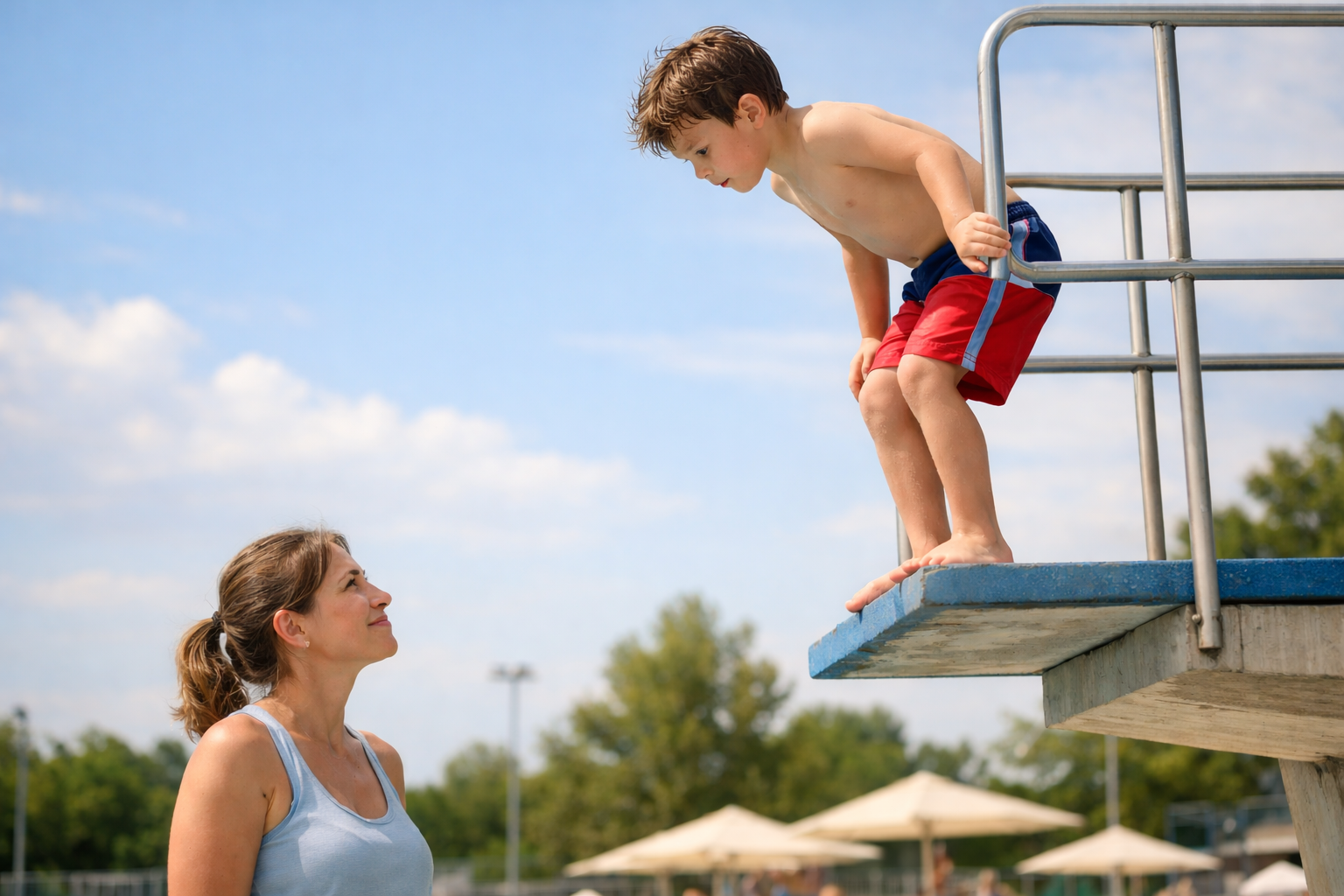
We have a complicated relationship with fear in this house.
Most of us grew up hearing some version of the same message: be brave, don't be scared, you've got this. We said it with love. We still say it. But underneath it was a quiet assumption — that fear is the obstacle. That the goal is to feel less of it.
This month, we want to turn that around.
April is our Courage in Action month, and we're spending four weeks inside one of the most useful ideas we've come across in parenting: that fear isn't actually the enemy of courage. It's the ingredient.
We're starting with a researcher who spent years trying to figure out what courage actually is — not philosophically, but mechanically. What's happening when a person acts despite being terrified? Is it something you're born with, or something you can build?
What he found was a formula. And it's one you can use at the dinner table tonight.
STORY
Jeffrey A. Gibbons, PhD — The Mathematics of Courage
Dr. Jeffrey Gibbons did not set out to change how parents talk to their kids.
He was a researcher, interested in what he called the bio-psychological mechanics of courage — the actual internal experience of a person in the moments right before they do something hard. What was the fear doing? What was the willingness doing? Were they working against each other, or somehow together?
Most people assumed courage looked like low fear. The warrior who charges without trembling. The kid who just jumps — no hesitation, no looking down. We tend to admire that. We hold it up as the standard.
But when Gibbons ran his studies and began looking at the data, something kept showing up that didn't fit the assumption: the people who scored highest on courage weren't the ones who were the least afraid. They were often the most afraid.
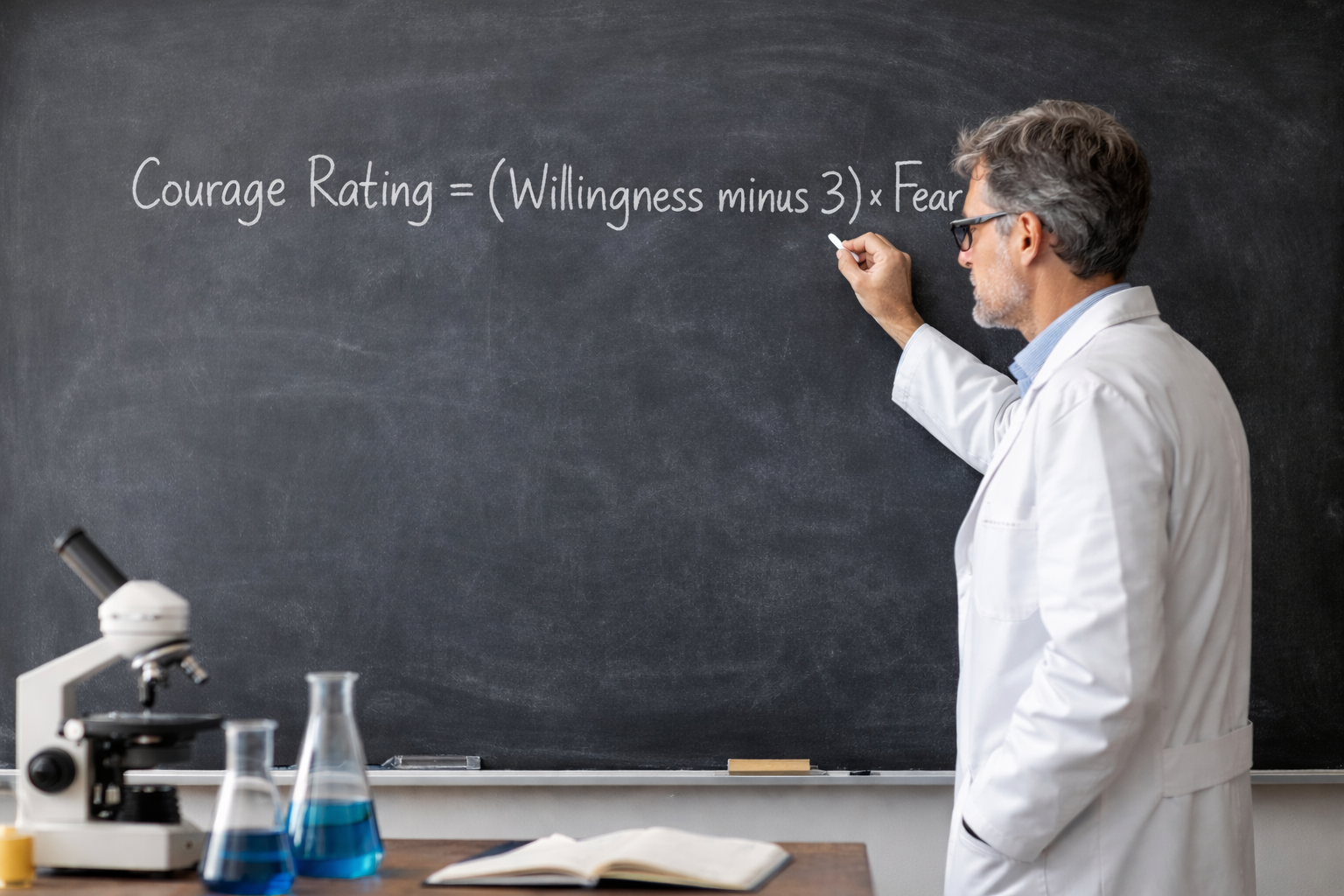
He refined his findings into a formula:
Courage Rating = (Willingness minus 3) x Fear
Run the numbers slowly. A child who rates their fear at a 5 — genuinely terrified, stomach tight, hands shaking — and rates their willingness to try at a 5 — deeply motivated to move forward despite everything — gets a courage score of 10. That's the maximum the formula allows.
Now imagine the child who feels no fear at all. Maybe they don't understand the risk. Maybe they don't care about the outcome. They walk right in. Their courage score? Zero. Not because they're weak but because without fear, there's nothing to move through. Gibbons called that compliance, or recklessness. Not courage.
He tested this across age groups, across physical challenges, social challenges, intellectual ones. The pattern held. Fear wasn't the obstacle to courage. Fear was the prerequisite.
The children who learned to stay willing even when terrified — who didn't try to get rid of the fear but learned to carry it forward — developed something the others didn't. A reliable internal sense that hard things were survivable. That they had been scared before and moved through it. And that they could do it again.
The quiet turn: fear isn't a signal your child isn't ready. It's confirmation that what they're attempting actually matters to them. Without it, there's no courage to speak of.
Which changes the whole conversation, doesn't it?
Instead of 'don't be scared,' the question becomes: how willing are you to try anyway? Those are very different things to ask.
SKILL
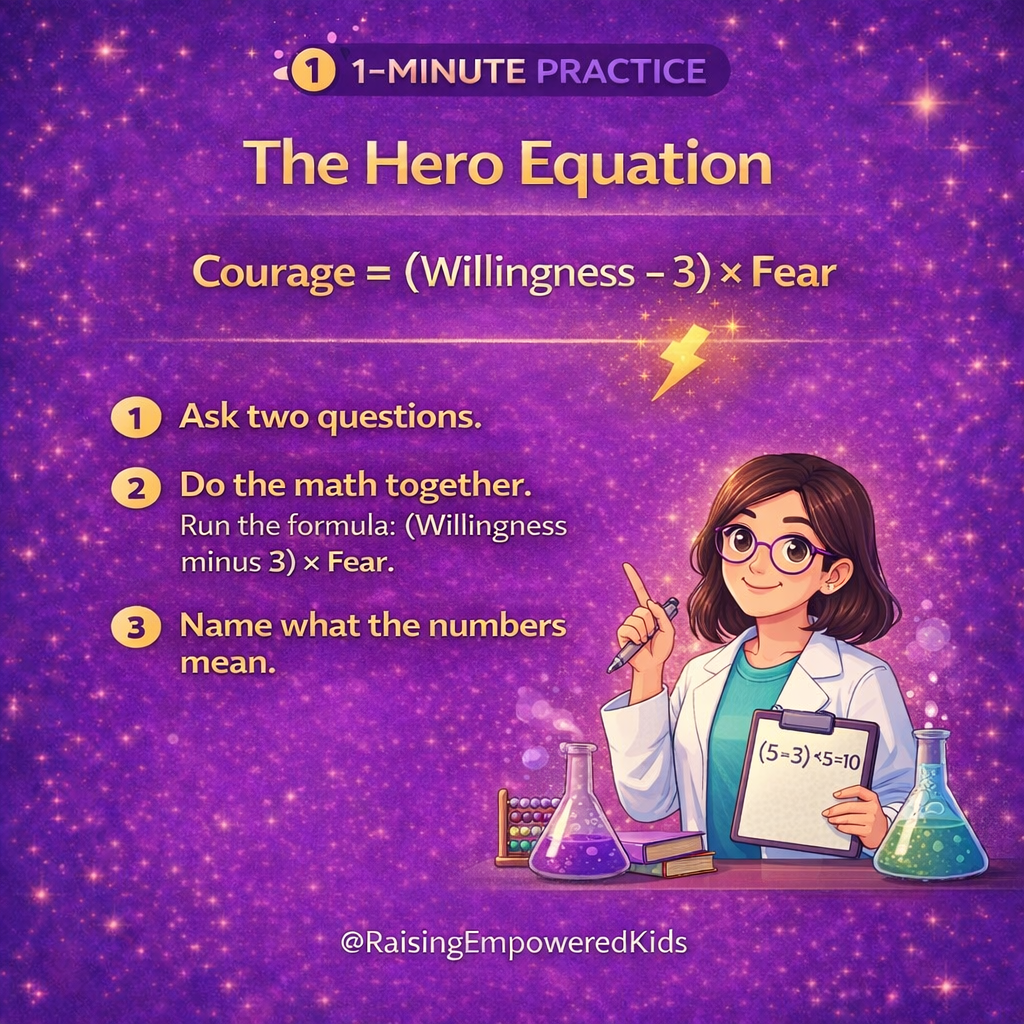
The Hero Equation
Two questions. A little math. That's it.
The next time your child freezes in front of something hard — a tryout, a class presentation, a conversation they've been dreading — try this instead of 'you'll be fine.'
1. Ask two questions.
"On a scale of 1 to 5, how scared are you right now?" Then: "And how much do you actually want to try?"
2. Do the math together.
Run the formula: (Willingness minus 3) x Fear. A willingness of 5 and a fear of 5 gives a courage score of 10 — the maximum. A fear of 1? Almost nothing to work with.
3. Name what the numbers mean.
"Your fear isn't making you less brave. It's what makes the brave possible. You can't get a 10 without it."
Two questions. A little math. It reframes the whole thing and works just as well for the grown-ups in the room.
Before you go…
April is a good month for this.
Spring is full of moments that ask our kids to step up — tryouts, recitals, end-of-year pushes, friendships that are shifting. The fear is already in the room. We're just giving it a new name.
Next week, we look at courage through a completely different lens — through the science of emotional agility, and what happens when we help kids stop fighting what they feel and start getting curious about it instead.
Watch Kathryn Hecht show how facing fear (yes… even licking the bottom of her shoe) reveals what kids actually need to become resilient.
Source: Kathryn Hecht’s How to Raise Kids Who Can Handle Hard Things | TED
One more thing before you go — happy Easter weekend. 🐣
If you're looking for something to do with your kids over the long weekend, our Easter Adventure Bundle was built exactly for this kind of time together: activities, prompts, and mini-challenges that spark curiosity, conversation, and a little brave action.
We're offering it one last time at the current price this weekend.
👉 Grab the Easter Adventure Bundle here
Your friends at REK,
Adam & Matthew Toren, Sylvia Tam, and Tammy Vallieres

Our new member hub is live — free activities, conversation starters, and resources for your family. Access it here.
“Courage is not the absence of fear, but the judgment that something else is more important than fear.”